Why is recording video by yourself so hard for B2B experts?
Because solo video makes your brain perform at a lens instead of talk to a person. The fix is not more willpower. It is an interviewer on the other side.
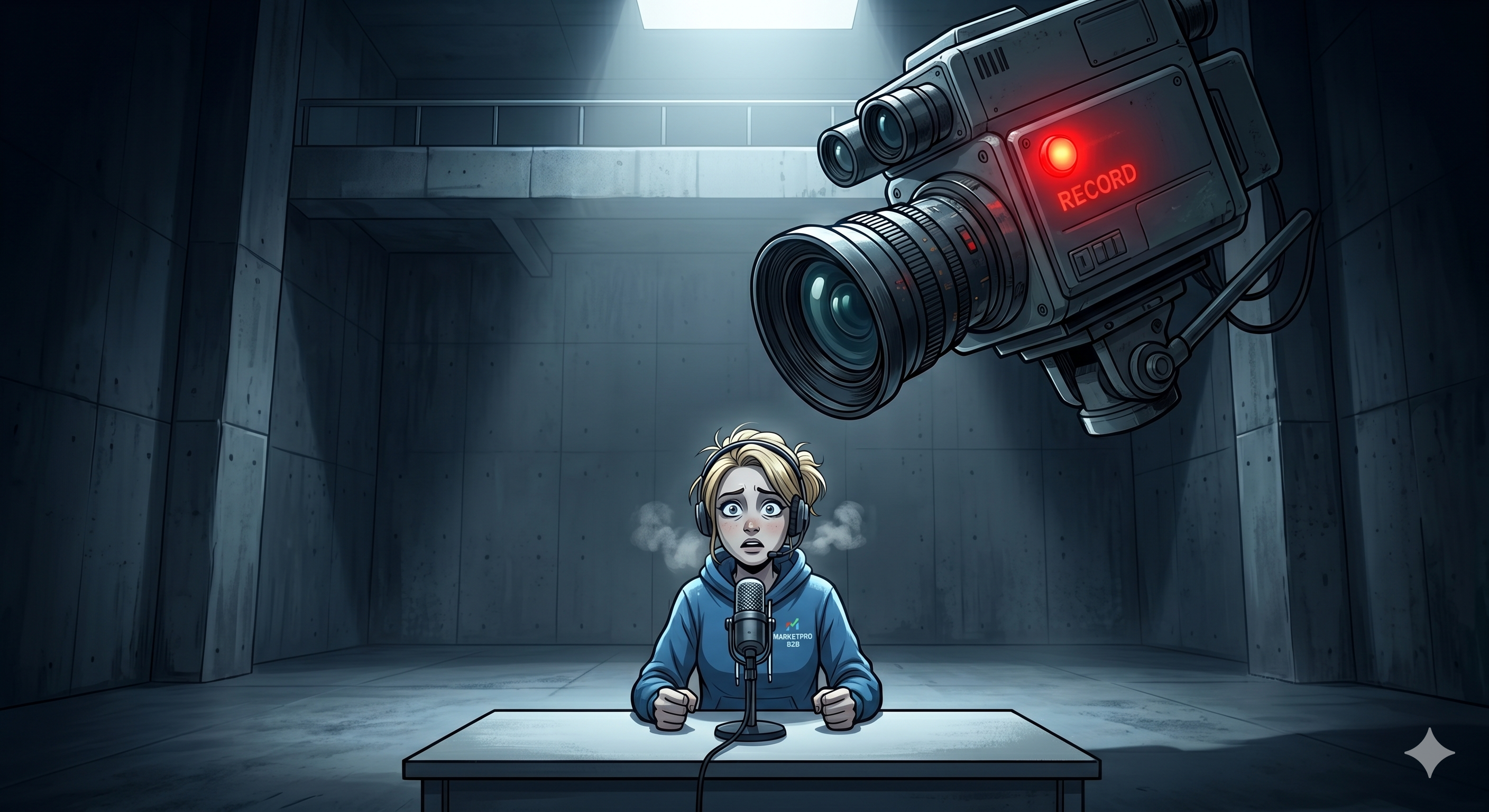
Because solo video forces you to perform at a lens that never reacts, your brain has nothing to push against, so the footage comes out stiff or rambling. The fix is not more discipline. It is an interviewer on the other side of the camera.
Quick Answer
- Solo video gives you three bad options: read a teleprompter (stiff), memorize (stiff plus panic), or wing it (human but rambling and off-message).
- The real problem is not gear or motivation. A camera does not react, does not laugh, does not ask "wait, why?" right when the better answer is sitting one layer down.
- Humans are built to talk to each other, not to a tripod. An interview format gives your brain something to push against, so the footage comes out alive instead of read.
- It works remotely. Set up right, you get the warmth of a real conversation with nobody traveling.
- One shoot is not one video. Pre-purpose it and a single hour becomes the long-form piece, the clips, the quotes, and the cited content, working for months.
The other day I was talking with a freelance B2B writer and strategist about the challenges she was facing with her content. If you want to see what the finished version of this looks like for a real team, here is one we built.
Why text alone stopped carrying the weight
She already knew the thing most experts know. Humanizing, trust-building content could grow her business. More visibility. More trust. More inbound.
She also knew text is only part of the answer now. In the age of slop, text does not always carry the weight it used to. Readers have to stop and assess whether it was ghost-written or generated. Thought leadership video does the heavy lifting on trust and visibility because it is harder to fake a real person thinking out loud.
So she rolled up her sleeves to record. And she hit a wall. Not the gear. Not motivation. Something else, and she could not name it.
She said it best: "If I have to record by myself, I'm just not going to do it."
The real problem: you are talking to a tripod
We talked it through and it got clear. The problem was that she was talking to a tripod.
A camera does not react. It does not laugh at the sharp line. It does not ask "wait, why?" right when the real answer is sitting one layer down. So your brain has nothing to push against.
It makes sense, because solo video only gives you bad options:
- Script it and read off a teleprompter. Clean, but stiff. Unless you are an actor, it reads fake.
- Memorize it. Same stiffness, plus the panic of forgetting your next line.
- Wing it. Now you are human, but you ramble and miss the stat that mattered.
Every one of those is one person performing at a lens. That is not how humans talk. We are built to talk to each other.
The better way is an interview
Two people. A real back-and-forth. Dynamic. Humanizing. And you can do it remotely, which is what I do a lot of. Set it up right and you get the warmth of a real conversation without anyone traveling.
That is the missing piece. Not more willpower. An interviewer.
And it is a fair thing to be stuck on. Being on camera is exposing. Being on camera alone is worse. No one to carry the silence, no one to tell you the last take was the one. Most people who "should" make video just do not, for exactly this reason. She was not behind. She was stuck on the one part that was never hers to solve alone.
If you want to find out where AI search and video already cannot find you, our free AI Visibility Snapshot shows you the gaps in a few minutes. No cost, no call required.
The interviewer's job is to make you forget the camera
That part is mine. More than 1,000 interviews over 30 years. The whole job is making the person across from me forget the camera is there.
Ask the question that pulls the better answer. Laugh at the right moment so she relaxes. When it gets fun, her pace changes, and the footage is alive instead of read.
So here is what it looks like for her. No script. No teleprompter. No memorizing. She shows up and talks about the thing she knows better than anyone in the room. I bring the questions. She brings the expertise.
One shoot, ten-plus assets
And one shoot is not one video. We pre-purpose it. That single sit-down becomes the long-form piece, the clips, the quotes, and the cited content. One hour of her time. Ten-plus assets working for months. Visibility, trust, and pipeline. And we even have fun doing it.
She did not need more discipline. She needed someone on the other side of the lens.
Maybe you do too. If you are ready to put one hour on the calendar and walk away with months of content, book a quick call and we will set up your first interview.
Frequently Asked Questions
Why is it so hard to record video by myself?
Because a camera does not react. It does not laugh, does not follow up, and does not pull the better answer out of you. Your brain has nothing to push against, so you end up either stiff (reading a script) or rambling (winging it). Humans are wired to talk to each other, not to a lens.
Is a teleprompter a good solution for solo video?
For most experts, no. Reading off a teleprompter is clean but stiff, and unless you are a trained actor it reads as fake. Memorizing adds the panic of forgetting your lines. Both still leave you performing at a lens instead of having a real conversation.
Does an interview format require travel?
No. Interviews work remotely. Set up right, you get the warmth of a real back-and-forth conversation with nobody traveling, which is how a lot of these get done.
What does "pre-purposing" a single interview mean?
It means one sit-down becomes many assets, not one video. From a single hour you get the long-form piece, the short clips, the pull quotes, and the AI-citable written content. One hour of your time turns into ten-plus assets that keep working for months.
How do I get started?
Start with the free AI Visibility Snapshot to see where AI search and video cannot find you yet, or book a quick call to set up your first interview.