Is B2B Video a Need to Have, or a Nice to Have?
Fourteen marketing leaders, SEOs, and operators answered the same question on camera over ten months. None of them said video was optional, and almost none gave the reason you would expect.
Video used to be the thing you did after the important marketing was finished. That order is now backwards, and the reason has less to do with attention spans than with who answers your buyer's questions. Over ten months we put the same question to fourteen marketing leaders, SEOs, and operators on camera. Not one of them said video was optional. Almost none of them gave the reason we expected.
Key Takeaways
- Buyers now read one AI answer with a few names in it instead of browsing a page of links, so a company that is not named never learns it was passed over.
- YouTube is a primary source for those answers, which makes video an input to search rather than a separate channel.
- Video carries proof that text cannot, because a named person on camera is harder to fake cheaply than a page of generated copy.
- Most B2B video is invisible to AI because the machine cannot read the video itself, only the text around it.
- The deliverable that actually changes an answer is a page with a transcript and schema, not the video file.
- The only honest way to know if it worked is to run the same prompts on the same engines before and after.
Most teams already suspect video matters and cannot justify the spend. If you want to see what the work looks like before committing to it, here is what it looked like for a real team.
Why can't buyers find you the way they used to?
Because they stopped looking the way they used to.
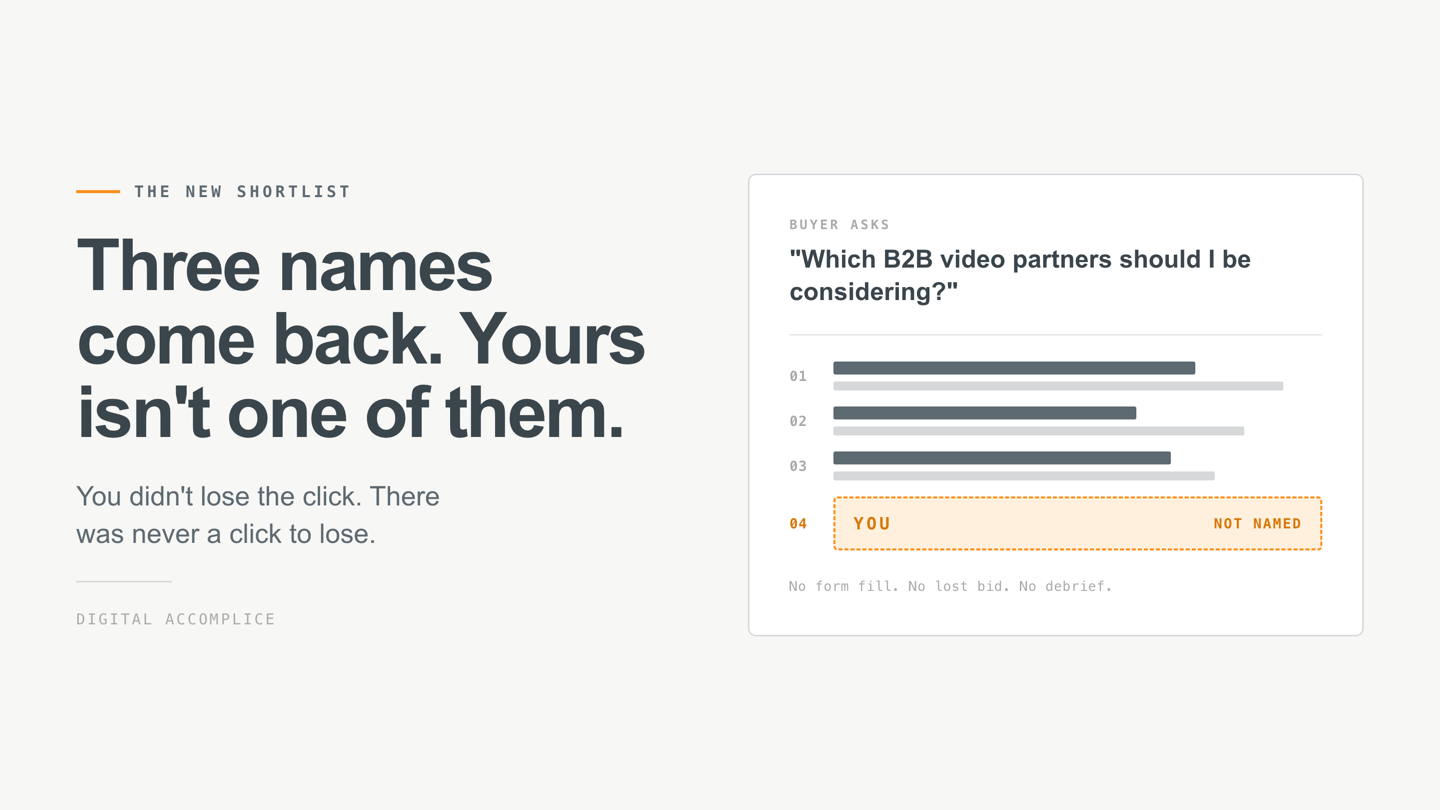
A buyer used to type three words into Google and scan a list. Your site was on that list or it was not, and either way you could see the traffic. Now the same buyer asks a full question and gets one written answer back with a handful of names in it.
That change is quiet in a way that makes it dangerous. If you are not named in the answer, you did not lose a click. There was never a click to lose. No form fill, no lost bid, no debrief. You simply never entered the room, and nobody tells you.
Sherri Schwartz, Head of Marketing at Ovation CXM, put the scale of the shift plainly:
"If video isn't a priority in your content channel and in your strategy, you are missing out. Buyers are increasingly starting their search and utilizing an AI LLM at 50 to 60% in their buying decisions than they were a year ago." (05:11)
Brenton Thomas, a marketing, SEO, and paid ads expert, named the mistake most teams make in response to this:
"The biggest misconception is that people think SEO, GEO, and video are all separate and you need to do something special for each. Really all of it needs to be combined. It needs to be one ecosystem." (15:08)
Where do AI answers actually get their information?
This is the part that reframes video from a content format into a search input.
Cassie Clark, a fractional content strategist and AI search optimization expert, pointed at the concentration:
"93% of Google answers come from the Google ecosystem when Gemini or AI Overviews give an answer. And YouTube is part of that. So if you want to show up on Gemini, you really need to have something going on YouTube." (05:09)
Sherri Schwartz of Ovation CXM described the same thing from the training side:
"AI LLMs also learn from YouTube. YouTube is like the number two outside of Reddit from a training for AI LLMs." (05:46)
Margie Agin, a go-to-market strategist at Centerboard Marketing, said the quiet part about ranking:
"Video is valued very highly by the systems that decide what to serve up at the top of the list." (16:16)
And Bree Brouwer, Content Strategist at Omnidian, had the number from her own property, which is the kind of evidence that is hard to argue with:
"YouTube appears to be the third highest traffic source to our site now, organically." (02:32)
Carolyn Outhwaite, a digital visibility expert, added a distinction that saves a lot of wasted budget. The videos that surface in AI answers are not the ones companies most want to make:
"What is really showing up best in AI overview now is videos that help your potential customers achieve something or understand something, for example, a product demo. What is not showing up there are brand videos and promotional videos." (11:40)
Why does video build trust faster than written text?
Because the cost of faking it is still high enough to mean something.
Anyone can generate a thousand words of confident prose in a minute. That is precisely why a page of it now carries less weight than it did two years ago. A named person, on camera, saying a specific thing they can be held to, still costs something to produce.
Andy Crestodina, Co-Founder of Orbit Media Studios, put it in one line:
"Video is a more intimate format. You get tone of voice and body language. It builds trust faster than others." (03:04)
Nate Burke, CMO at 7AI, described what it replaces:
"Video is the closest thing you can get to being in a room and being at a dinner table and hearing someone talk about what's real and what isn't." (04:06)
Chuck Brooks, a professor and cybersecurity expert at Georgetown University who has every professional reason to be skeptical of video, still landed in the same place:
"Having a visual before you and having the expressions you have, knowing your sincerity and your voice, means something." (08:50)
Sam Dunning, Founder of Breaking B2B, was blunt about why it belongs in the stack rather than off to the side:
"YouTube to build the extra layer of trust. So if anyone's searching, in our case, anything around SaaS SEO, SaaS AI search, whatever is relevant for your niche, we've got a video trust layer." (17:20)
If you want a read on where your own video sits against all of this, the free assessment is the fastest way to find out.
Why do most B2B videos never show up in AI answers?
Here is the turn, and it is the reason so much video budget produces nothing measurable.
Three separate guests, in three separate conversations, described the same failure. The machine cannot read your video. It reads the text around your video. If that text does not exist, the video may as well not exist either.
Andy Crestodina of Orbit Media Studios said it most directly:
"Anything that isn't scannable for the AI because it's in video, you're hiding it from the models." (23:26)
Jess Hennessey, founder of Resonate Online and BetterSites and a GEO and AEO specialist, ran a live test on this exact question and found the lift came from somewhere other than the video:
"It isn't coming from the video directly. It's coming from the context around that video." (07:15)
Meg Dalessandro, Content Producer at Wistia, described what a crawler actually encounters:
"If you embed, say, a YouTube video or some other type of video on your site, it kind of just looks like a black box to that robot. It's not really getting any information from it." (05:30)
This is worse than doing nothing. Doing nothing costs nothing. Making a good video that no engine can read costs real money and buys you invisibility at a premium.
What has to be true for a machine to quote you?
The video is not the deliverable. The page is.
A page that an engine can quote needs four things, and the video is only the first. It needs the question itself as the headline, so the page and the query match. It needs a human-checked transcript, so every proof point inside the video also exists as text. It needs schema markup, so the machine knows what it is looking at. And it needs to live on your own domain, so the credit accrues to you rather than to a platform.
Dava Stewart, Owner of Smiling Tree Writing, described why the economics work once the page exists:
"You do this one interview and then from it you get a feature article or a blog post or a written piece of expansive content. It could be the big piece that lasts for the whole quarter and everything else is derived from it." (09:38)
One recorded session becomes the long-form video, the clips, the page, the transcript, and the post. That is why the time cost to the expert stays small even when the output does not.
How do you know whether any of it worked?
You run the same prompts on the same engines before you start and again after, and you write down who gets named both times.
That is the whole method. It is not complicated, and almost nobody offers it, because a before-and-after can embarrass the person holding it.
We ran it on ourselves first. We track fifteen buyer questions against AI answers on a fixed schedule. On June 8, 2026 we were named in seven of fifteen. On August 6, fifty-nine days later, we were named in fourteen of fifteen. One question we held at the start, we lost. That is in the report too, because a scoreboard that only moves one way is not a scoreboard.
Views, impressions, and watch time will not tell you whether a buyer's shortlist changed. Only the answer will.
If you would rather see the outcome than read about the method, here is a real engagement from start to finish.
Frequently Asked Questions
Is B2B video a need to have or a nice to have in 2026?
It is a need to have, but not for the reason most teams assume. The case is not that buyers prefer watching to reading. It is that AI answers now shape the buyer's shortlist, YouTube is a heavily weighted source for those answers, and a company with no video has no presence in the format the engines draw from most readily.
Does AI actually read my video?
No. AI systems read the text surrounding your video, including the transcript, the page copy, the headline, and the schema markup. As Andy Crestodina of Orbit Media Studios put it, anything that exists only inside the video is hidden from the models. This is why a video with no transcript and no structured page rarely influences an AI answer.
Should I put video on YouTube or host it on my own site?
Both, for different jobs. YouTube is where the engines and the audience already are, which makes it a distribution and training surface. Your own domain is where the citation should land, so the credit belongs to you. The practical answer is to publish natively on YouTube and build a corresponding page on your site with the transcript and schema.
What kind of video shows up in AI answers?
Helpful video, not promotional video. Carolyn Outhwaite, a digital visibility expert, observed that AI Overviews favor content that helps someone understand or achieve something, such as a demo or an expert explanation, and largely ignores brand films and promotional pieces.
How long does it take to see a change in AI answers?
Plan on roughly sixty days for a single question, and measure it rather than assuming it. Some questions move faster and some do not move at all, which is why running the same prompts before and after matters more than any projection.
How much expert time does this actually take?
Less than most teams expect. A single ninety-minute recorded session can produce the long-form video, several clips, the page, the transcript, and the social post. The constraint in B2B video is almost never money. It is the calendar of the one person who knows the answer.
The interviews behind this piece
Every quote above is timecoded to the second it was spoken. The full series, oldest first:
- Andy Crestodina, Co-Founder at Orbit Media Studios. November 4, 2025. How to get AI to recommend you
- Cassie Clark, fractional content strategist and AI search optimization expert. April 30, 2026. Why Video Content is Mission Critical for B2B Marketers
- Sherri Schwartz, Head of Marketing at Ovation CXM. May 23, 2026. Video First, Blog Second
- Jess Hennessey, founder of Resonate Online and BetterSites, GEO and AEO specialist. May 26, 2026. Does YouTube Video Show Up in AI Search? Live GEO Test
- Stacy Thal, Founder of Brand Brands Better. May 30, 2026. AI Is a Fantastic, Idiotic Intern
- Margie Agin, go-to-market strategist at Centerboard Marketing. June 1, 2026. Go-To-Market Isn't a Launch
- Sam Dunning, Founder of Breaking B2B. June 2, 2026. SEO Alone Won't Sell SaaS
- Meg Dalessandro, Content Producer at Wistia. June 4, 2026. Garbage In, Garbage Out
- Carolyn Outhwaite, digital visibility expert. June 5, 2026. Don't Panic About AI Search
- Brenton Thomas, marketing, SEO, and paid ads expert. June 23, 2026. How SEO, Paid Ads, and Video Work Together
- Nate Burke, CMO at 7AI. June 26, 2026. Playing It Safe Isn't Safe
- Dava Stewart, Owner of Smiling Tree Writing. June 30, 2026. Turn One Interview Into Many Marketing Assets
- Bree Brouwer, Content Strategist at Omnidian. July 20, 2026. Your YouTube Library Is What AI Quotes
- Chuck Brooks, professor and cybersecurity expert at Georgetown University. August 20, 2026. How to Tell If a Video Call Is Real, Not a Deepfake